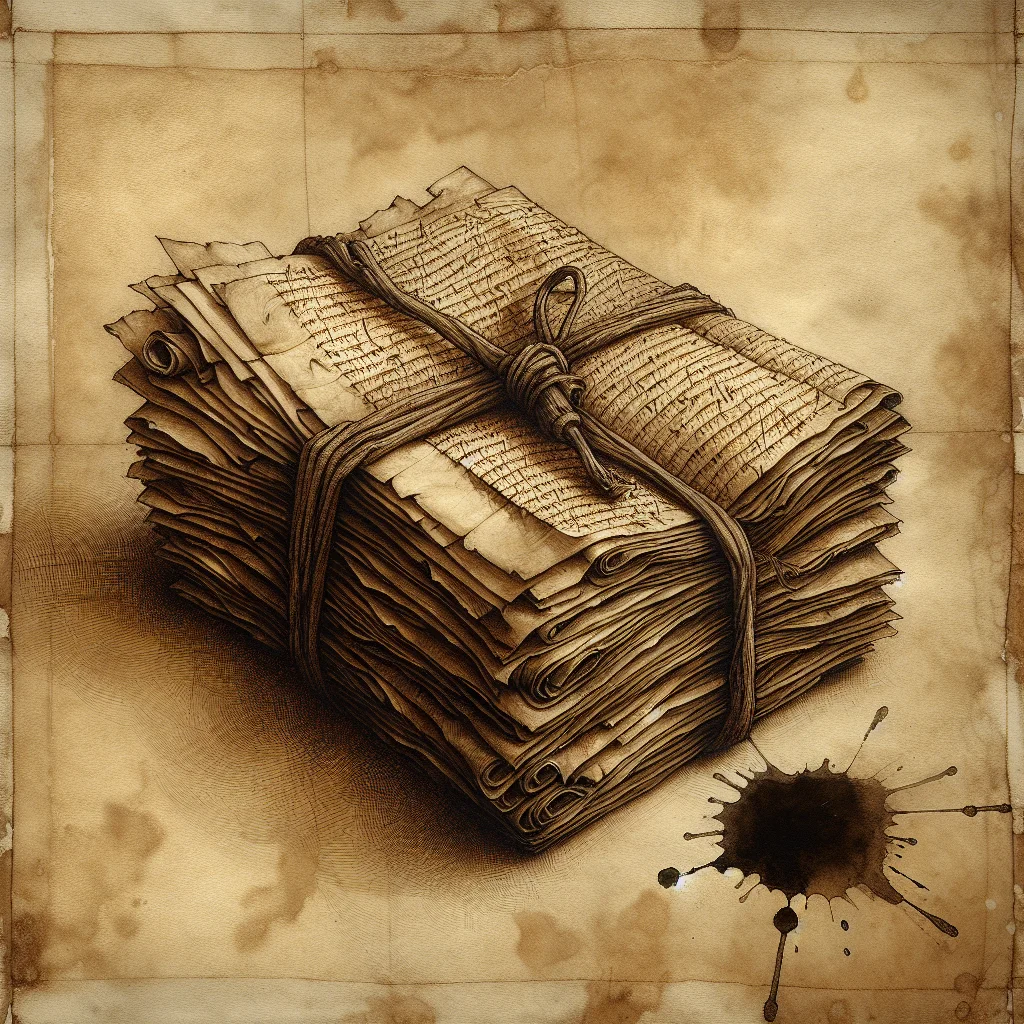
Chapter 96: Letters Never Sent
I BOUGHT THE paper from a tinker.
Good paper. Cream-colored, with a weight and tooth that spoke of a mill that took pride. The kind of paper you’d use for a letter to someone who mattered. Three sheets, because I knew before I asked how many I would need.
The tinker wanted two pennies. I gave him four and he looked at me strangely. I overpaid because I had forgotten how not to. Kvothe had always been careless with money, the way only someone who has been genuinely poor can be: spending freely when he had it, knowing from hard experience how quickly having becomes not-having.
I carried the paper upstairs. Sat at the desk in my room. The desk was oak, scarred and simple, bought at the same time as the bar and the bottles and all the other furnishings of a life I was building from nothing. There was a pen in the drawer. Ink. A small knife for sharpening. The tools of a man who has things to say.
The light through the window was late afternoon, the color of old honey, falling at the angle that makes dust motes visible. I cleaned every surface in the Waystone with the tireless devotion of a man who needed his hands to be occupied, but the dust always came back. Dust does not care how many times you wipe the surface.
I sharpened the pen. The blade of the small knife pared the nib to a clean edge, and the shavings curled away in thin spirals that fell to the desktop. The pen was simple reed, not the fine steel-nibbed instruments I’d used at the University. It would skip on the upstrokes. It would blot if I pressed too hard.
That was why I’d chosen it. Reed pens make you feel every word.
I dipped the pen and touched it to the surface, and the mark it left was sharp and clean and somehow more real than anything else in the room. The ink smelled of walnut hulls and iron gall, and for a moment the scent carried me back to the Archives. The long tables. The smell of old binding glue. The scratch of a dozen pens in the reading room. Wilem beside me, his silence a comfortable weight. Simmon on my other side, fidgeting, tapping his pen against his teeth until Wil reached over without looking and pressed the pen flat against the table with one finger.
I closed my eyes. Opened them. The room was still the room. The desk was still the desk.
I began with Wil.
Not immediately. There was a false start first.
I wrote his name at the top of the page — Wil — and then sat looking at it for what felt like a long time. Three letters. The shape of a man reduced to the smallest possible notation.
I’d written thousands of words at the University. Courtship letters for the Maer that made a woman weep with longing. Songs that are still being sung in taverns I will never enter again.
And yet for several minutes I could not write a single sentence to my friend.
The problem was not knowing what to say. The problem was knowing that whatever I said would be a performance. To write a letter to Wil — honest, plain, without the armor of rhetoric — required a nakedness I was no longer sure I possessed.
I set the pen down. Picked it up. Set it down again. Picked it up and wrote.
Wil,
I’m writing this letter that I won’t send. You’d think after all these years of silence I’d have worked out what to say, but the only words that matter are the ones you can’t find.
So I’ll be blunt. Cealdish.
Thank you.
For the nights at Anker’s when you sat across from me and said nothing and the nothing was exactly what I needed. For the money you lent when my pride should have prevented me from asking. Because you never once asked me to explain myself. Cealdish friendship doesn’t require explanations, only loyalty.
I remember the night after the plum bob incident, when I was still shaking and couldn’t keep my hands steady enough to eat. You cut my bread for me. Didn’t say a word. Didn’t look at me while you did it. Just cut the bread and set it in front of me and went back to your own plate, and the matter was closed. In Atur, someone would have asked if I was all right. In Modeg, someone would have made a show of concern. You cut the bread. That was all.
I have thought about that bread more than you would believe.
You went home after everything fell apart. You married. I imagine she’s practical and sharp and too good for you. I imagine you have children with your jaw and your stubbornness. I imagine they drive you mad and you love them with that quiet ferocity you brought to everything, to Sim and me, though you’d sooner swallow a live coal than say so.
You became a merchant. This surprises me not at all. You always understood the difference between what something costs and what it’s worth. I imagine you behind a desk of dark Cealdish oak, tallying ledgers, drinking that terrible black tea you favored, looking at the world with those steady eyes that never flinched from the arithmetic of hard things.
Do you think about us? About the nights in our rooms when Sim would read his poetry and you’d pretend to hate it? About the time we climbed the Mains rooftop during the fire and you swore in three languages and then climbed anyway because I asked? Do you think about Sim?
I know you do. And I know you grieve the Cealdish way: privately, practically, converting loss into something useful. A fund for his family, perhaps. A toast on the anniversary. Something solid.
There’s a Cealdish proverb you told me once: “A friend who tells you what you want to hear is a merchant. A friend who tells you what you need to hear is a brother.”
You were my brother, Wil. And I never told you, because I was too proud and too busy to say the simple, obvious things.
I miss you. I’m sorry. Thank you.
Your friend, Kote
I set the pen down after finishing Wil’s letter and flexed my hand. The left one. It had been resting on the desk, steadying the paper, and when I lifted it I saw that the last two fingers had left no impression on the wood. As if the weight of them had become too slight to register.
The light had shifted while I wrote. The honey turning to amber turning to the thinned-out gold that comes just before evening.
I dipped the pen again. Set the nib to a fresh sheet.
Fela,
You lost Sim because of me.
I know the argument against this. I can hear Sim making it: “It wasn’t your fault, Kvothe. I made my own choices.” And he’d be right. Good people are always right when they refuse to let you shoulder what you’ve earned.
But he’s not here to make that argument. He’s not here because the path I cut through the world was wide enough to pull the people I loved into its wake.
Sim died because he was brave and believed in me more than I deserved. He died being Sim. Still trying to make someone smile. Still thinking of the people he loved.
The last thing he said was your name.
I stopped writing.
I had not planned to say that. It had come out of the pen like a splinter working free of the skin: slowly, painfully, arriving at the air not because you willed it but because the body can no longer hold it in.
It was true. I had been there. I had heard it. One syllable, spoken through lips that were already losing their color. Not my name. Not a prayer. Hers. The name of the person who mattered most, spoken as the last deliberate act of a man who had always known what mattered.
I sat with the pen hovering above the page, a bead of ink swelling at the nib’s tip. I tipped the pen back before it could blot. Breathed. Continued.
Word reaches me, even here. You rebuilt the Archives. Not just organized. Rebuilt. They say you walked through the wreckage the morning after and put your hands on the broken stone and spoke to it in the old language, the one that has no words. They say the stone answered. That walls straightened. That cracked lintels sealed. That you did with patience and naming what a hundred masons couldn’t have done in a year.
You became a Master. The youngest El’the in a generation, and now a Master. It suits you. You were always stronger than any of us. The strength of stone. Patient and sure. While I was hiding in a country inn, serving drinks to men who don’t know my name, you were doing the actual work of repair. Sorting through ashes. Finding what could be saved.
You kept his things, I hope. His books. That ridiculous hat he wore to the Eolian. The poetry he pretended was bad so people wouldn’t take it too seriously. Perhaps you gave them to his family. Unless you couldn’t bear to do either, and they’re sitting in a room somewhere, waiting for a decision that never comes.
I wonder if you hate me. I would understand if you did. Some days I think your hatred would be easier to carry than your forgiveness.
You deserved better than what I gave you. Both of you did.
I’m sorry.
Kote
The second letter had cost more than the first. I could feel it in the set of my jaw, in the place behind my sternum that ached with the dull persistence of an old bruise.
I stood up from the desk. Walked to the window. The glass was old and uneven, bubbled in places, the world beyond it slightly warped. The road led out of Newarre, empty as always, curving away between hedgerows toward the wider world where people still knew my name and wanted me dead for it.
The light was fading. I sat back down in the gathering dusk and reached for the third sheet.
The third letter came more easily, because Devi had never required tenderness from me and I had never offered it.
Devi,
I don’t know why I’m writing to you. We were never friends. We were adversaries who respected each other. Two people who understood the same dangerous things.
You’re still in Imre. You built something there, a network of information and influence that dwarfs your old gaelet business. This does not surprise me.
You looked at every lock, every wall, every rule and saw the seams where pressure could be applied. Most people never even noticed the seams.
I owe you, Devi. The debt isn’t money. It’s something harder to name. When every other door in my life was closing, yours opened. For a price, always for a price, but it opened.
And that’s the thing I can’t untangle. The knowledge you traded me, the connections you brokered, the doors you pried open with that terrible clever leverage of yours. I used them. I used all of it. And people died, Devi. Not because you pulled the trigger. Because you handed me the bow and I was too brilliant and too stupid to see where I was aiming. Every tool you gave me worked exactly as intended. I’m the one who pointed them wrong.
You’d hate this letter. Too sentimental. You’d evaluate the emotional content for potential exploitation, then set it on fire. You’d tell me sentiment is a luxury and that if I wanted to express gratitude, I should send money or useful information, not ink-stained feelings on cream-colored paper.
Gods, I miss arguing with you.
And if you ever hear a rumor about a red-haired innkeeper in a nowhere town, do me the courtesy of forgetting it. The debt between us is settled. Whatever I borrowed, whatever you lent. The ledger is closed.
Consider it paid in full.
With grudging respect, Kote
Three letters. Three sheets of cream-colored paper. The ink was drying, the words settling into the tooth of the page like seeds into soil.
I laid them side by side on the desk. Wil. Fela. Devi. Three people I had loved, in three different ways, to three different ends.
The room was nearly dark now. The last light caught the edge of the desk, the lip of the ink pot, the corner of each letter where the paper curled slightly as the ink dried. Small details. The kind you notice when you are trying very hard not to notice the larger thing.
I picked up the first letter. Reread the opening line. I’m writing this letter that I won’t send.
Put it down.
My handwriting had changed. Not dramatically. But the letters were smaller, more careful, lacking the confident slant that had once been second nature. Kvothe’s handwriting had been quick and loose, the script of a man in a hurry to get to the next thing. Kote’s was measured. Deliberate. The handwriting of a man with nothing but time.
There was a fourth sheet.
I should tell you about the fourth sheet, because the story of what we don’t do is sometimes more important than the story of what we do.
There was a fourth sheet in the desk already, left from some earlier errand — an inventory list, half-completed, abandoned. The back of it was blank. Good enough for something I wasn’t going to send anyway.
I pulled it out. Smoothed it flat. Picked up the pen.
I sat there for a long time.
The pen did not touch the paper.
I knew what I wanted to write. I knew every word of it. The letter existed whole in my mind, complete as a song before the first note sounds, every rest measured. I could have written it from memory because it was memory, because I had been composing it in the dark hours between midnight and dawn, revising it as you’d return to a wound.
Denna,
That was as far as I could go in ink.
The rest lived only in my head, and that is where it will stay. I am not going to tell you what the letter said. Because some words, once written down, become true in a way they weren’t before. A thought held inside is a private sorrow. A thought on paper is a confession. And a confession can be found.
I will tell you this much: the letter was not an apology. You do not apologize for killing someone. You do not write I’m sorry to a woman whose breath you stopped with a word, whose name you spoke and unmade in the same syllable. Sorry is for broken dishes and missed appointments. What I had done to Denna had no word, in any language, including the ones that have no words at all.
The letter was not a love letter either, though it contained love the way a flooded river contains rain. It was not a goodbye, because goodbye implies a departure, and I had not departed from Denna. I had destroyed her.
What it was, if it was anything, was an accounting. The gap between the man I believed I was and the man I turned out to be. That gap, measured in lives, measured in silence, measured in the specific weight of a woman’s last breath as it left her body and entered the indifferent air.
I held the pen above the blank paper for perhaps ten minutes. The ink dried on the nib. The light left the room.
Then I put the pen down.
I did not write the letter to Denna. I want you to notice that. Some letters are too heavy to write, even to a grave. Some names, set down in ink, would burn through the paper and the desk and the floor and keep burning until they reached whatever is beneath everything.
Her name. Five letters. Less than Kvothe. Less than Kote. And I could not bring myself to write it on a scrap of inventory paper in a dark room in a town that no one had ever heard of.
I folded the three letters. Carefully. Three folds each. The paper resisted slightly, the good stock holding its shape, but yielded in the end. Everything yields in the end.
I laid them in the empty desk drawer, side by side. Flowers on a grave.
The fourth sheet — the blank one, the one with nothing on its front except the memory of a pen hovering above it — I folded that too. Same folds. Same care. I laid it beside the others.
Four letters in a drawer. Three written. One unwritten. The written ones would never be sent because sending them would mean admitting I was still alive, still here, still Kvothe enough to owe debts, to feel the pull of the life I’d abandoned. And the unwritten one would never be written because writing it would mean admitting something worse.
That I could still feel.
That the cut-flower sound I was becoming had not yet reached the root. That somewhere beneath the innkeeper, beneath the name, beneath the silence, there was a man who missed a woman so badly that even the thought of her name on paper was enough to stop his hand.
I closed the drawer.
Stood up.
The desk was dark. The room was dark. The ink pot sat uncapped, and I reached for it in the darkness and found it by touch and pressed the cork home. The innkeeper’s reflex. Things should be put away. Things should be kept in order, even if no one is watching.
Then I went downstairs and stood behind the bar with my hands at my sides, and the silence of the Waystone settled around me, and I was Kote again, just Kote, the innkeeper who had never written anything to anyone and never would.
But the letters were upstairs. In the drawer. In the dark. Waiting as all unspoken things wait: patiently, persistently, certain that one day someone would open the drawer and find them and know that the man who lived here had not been empty after all.