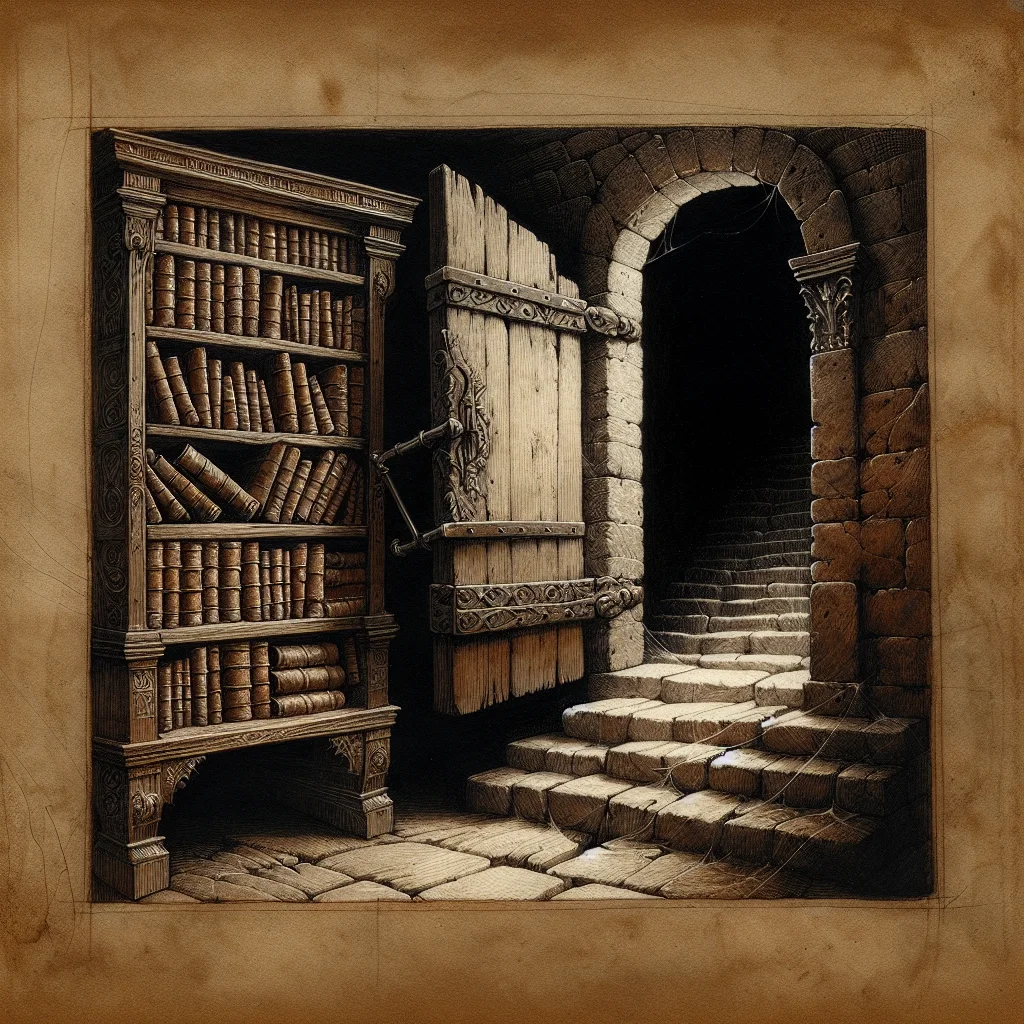
Chapter 14: The Hidden Library
AURI FOUND ME on the rooftop of Mains that evening, after I’d walked back from Devi’s rooms in Imre. Which is to say, I had been waiting for her.
There is an important distinction between the two.
Tonight she came carrying a candle.
A slender cylinder of pale substance that glowed without flickering, casting a light that was steady and cool and faintly blue, like starlight condensed into solid form.
Auri perched on the edge of the rooftop with her bare feet dangling over thirty feet of empty air. She held something out to me with both hands, as a child might offer a drawing.
“A brave thing,” she said. “For the deep-down.”
I took the candle. It was warm to the touch, warmer than the night air justified, and it smelled of clean stone and old water and a mineral sweetness, like honey made from flowers that grew in caves.
“Thank you, Auri.”
She nodded once, with the solemnity of someone agreeing to something momentous. Then she stood, light as a leaf in a thermal, and looked at me with those large, luminous eyes.
She turned and disappeared over the edge of the rooftop, and I heard the soft pad of her feet on the drainpipe, a sound no heavier than the memory of rain.
I followed.
I had been in the Underthing before. Many times, following Auri through her strange, careful kingdom of abandoned tunnels and forgotten rooms, each one named with a precision that suggested cartography more than whimsy.
Tonight, Auri took me somewhere new.
We descended through Cricklet, a narrow vertical passage that I navigated by feel, my shoulders scraping stone on both sides, the brave candle held in my teeth. The air changed as we went deeper. Warmer first, then cooler, then warm again. We were passing through layers of a sleeping body, each with its own temperature, its own breath.
We’d descended perhaps a hundred feet by the time we reached the bottom, past the lowest level of the Archives, past the wine cellars beneath the Masters’ Hall. At this depth, the stone predated the University by millennia.
Below Cricklet, a passage I’d never seen. The walls were smoother, more deliberately shaped, the stones cut to fit so perfectly you couldn’t slide a hair between them. The air was cold and dry.
“This is old,” I said, running my hand along the wall. Beneath my fingertips I felt grooves, shallow, regular, purposeful. Carvings.
She remembered. Her bare feet found each turning without hesitation. At one point she paused beside a carved stone set into the wall at shoulder height, its surface worn smooth by centuries of passing hands. Without looking, her fingers traced a complex whorl of interlocking lines. Her fingertips knew the shape before they touched it.
I said nothing.
She paused at an intersection where three passages met. The ceiling here was higher, high enough that my candlelight couldn’t reach it. The air smelled dry and faintly sweet, with an undertone of old paper.
She took the left passage without hesitation and glanced back once to make sure I followed.
The passage sloped downward, gently at first, then more steeply. The carvings on the walls grew denser, patterns that repeated and varied and intertwined like the themes of a fugue. The brave candle’s blue light revealed them only in fragments, and the fragments refused to assemble into any coherent image.
Then the passage opened, and I stopped breathing.
The chamber was enormous.
A vaulted space that stretched upward into darkness beyond the reach of any light, its floor smooth and unbroken, its walls curving inward at the top like the interior of an egg. Or a barrow.
The thought came unbidden and wouldn’t leave. I had seen barrows before, the ancient burial mounds that dotted the landscape of Vintas. The architecture of those barrows — the curved walls, the fitted stones, the sense of deliberate permanence — was echoed here, magnified a hundredfold.
If it had ever been a tomb, it had long since been repurposed.
The chamber was full of books.
Books housed in alcoves carved into the walls, hundreds of them, each precisely sized to hold a single volume, each sealed behind a thin panel of glass so clear it was nearly invisible. The glass caught the blue light of the brave candle and scattered it in pale constellations across the floor and ceiling.
Auri touched my arm, very briefly, and pointed. Her lips moved, shaping a word too soft to hear.
I approached the nearest alcove. Behind the glass, a book lay open to a page covered in angular, dense characters arranged in columns rather than rows. They shifted faintly in the candlelight. The ink itself was alive.
My hand reached toward the glass. Auri caught my wrist, gently, as you’d stop someone from touching a sleeping child. She shook her head once.
I pulled my hand back, and she released me.
The stone, the glass, the air itself spoke of an age that predated the Aturan Empire. Predated, perhaps, the Creation War itself.
I thought of Lorren and his careful kingdom above us. Did he know what lay beneath his feet?
Auri read the question in my face. She hugged herself, shook her head. The paths she walked weren’t the paths that showed themselves to everyone.
She moved through the chamber with the quiet certainty of someone returning to a place that was hers in some way more fundamental than ownership. Recognized, as a river recognizes its bed. And for a moment, in the blue candlelight, she stood differently. Straighter. Her chin lifted, her shoulders drawn back, carrying a bearing that did not belong to a girl who lived in tunnels and talked to the moon.
Then the moment passed. She tilted her head, birdlike, and she was Auri again. Small, bright, delicate as a wish.
She had been here before she was here.
We explored the chamber together, moving from alcove to alcove with the methodical reverence of pilgrims visiting shrines. Auri guided me, not explaining, but pointing. Showing me how one thing related to another.
She paused before an alcove that held a large volume bound in something like leather that shimmered with an iridescence no leather possesses. She pressed her palm flat against the glass and closed her eyes. When she opened them, she mimed something, hands opening, sound emerging. Songs. The book held songs. Captured, preserved, waiting to be released.
She moved to another alcove. This one held a collection of thin stone tablets, stacked and bound with wire that had corroded to a greenish patina. The tablets were covered in characters that had grown from the stone itself, crystalline formations following the logic of language rather than chemistry.
Auri’s hand hovered near this one. Her expression changed, reverent, wary. She whispered a single word: “Doors.”
My heart beat faster.
Auri beckoned me closer, pointing to a specific tablet near the middle of the stack. Through the glass, the crystalline characters caught the blue candlelight and threw it back in fragmented patterns across the ceiling. Most of the text was impenetrable, angular shapes that my mind slid off like water from oiled leather. In one section near the tablet’s lower edge, the characters arranged themselves into something almost recognizable. Figures, human figures, standing in a circle around a shape that could only be a door. And from each figure, lines radiated outward into the door’s frame. Something was flowing from the people into the stone itself.
Not guarding it. Becoming it.
The realization settled into me like a stone dropped into still water. People had given their names — given themselves — to become the binding. Each name a living stone. Each person a piece of the lock.
The next tablet showed a pattern that repeated in variations across the stone’s surface, curving and folding back on itself with the structure of a song. A musical pattern. The intervals were there if you knew how to read them, rising, falling, resolving, beginning again. The deepest structure of reality was not mechanism or magic or mathematics. It was music. A song so vast and so old that everything — stone and star and name and silence — was merely a note within it. And naming, true naming, was a form of singing. Adding your voice to the great chord that held the world together.
The bone ring on my finger hummed faintly, resonating with something in the stone.
“Can these be read?” I asked. “If someone knew the language—”
She tilted her head, considering. Then she touched her chest, lightly, over her heart.
She had read some of these. I was certain of it, watching her move through the chamber, not exploring but revisiting. She led me to the far end, where the alcoves gave way to a stretch of wall covered in carvings so shallow and fine they were nearly invisible, readable only when the light struck them at exactly the right angle.
The brave candle’s blue glow caught them perfectly, and for a moment the wall blazed with text, thousands of lines of cramped, angular script, covering every available inch of stone from floor to ceiling.
Auri stood before the wall with her hands clasped behind her back.
I stepped closer. The text was in the same unknown script as the stone tablets, carved with extraordinary care, each character precise, the spacing so regular it could have been typeset. And woven through the text, a bright thread in a dark tapestry, were patterns I recognized.
Yllish knot-work. Flattened from cord-and-thread into carved-stone, but unmistakably the same fundamental language.
“This is a translation key,” I breathed. “This text, it bridges the old language and Yllish. It shows how they connect.”
My mind raced. If I could decode this bridge between Yllish and the older language, I might be able to read the stone tablets. Might find, somewhere in this hidden library, the techniques I needed to help Denna.
“I need to come back,” I said. “With paper. With ink. I need to copy these carvings—”
“No.”
The word was gentle but absolute. She shook her head once and pressed her palm flat against the stone beside the carvings. What’s here stays here.
Every instinct I had screamed at me to copy every character on that wall, to carry this knowledge up into the light where it could be studied and used.
I could learn. I could come here and sit and read and let the words shape my mind. That was what the library was for. Not for taking. For becoming.
“All right,” I said. “I’ll come and learn. But I’ll need time. And light.”
Auri nodded at the candle in my hand. The brave thing would last. It knew its job.
We sat on the floor of the chamber for a while, in the blue glow of the brave candle, surrounded by sealed books and the weight of more knowledge than I could comprehend. Auri sat cross-legged, her eyes half-closed. This place, far below the world, was more home to her than anywhere else.
I didn’t ask how she’d found it. The stones sang, down here, a song too low for most people to hear.
After a long silence, she reached into the pocket of her ragged dress and withdrew something small.
She held it out. A ring. Small, simple, carved from a single piece of bone polished until it glowed. Pale, almost white, inscribed with the same angular script that covered the walls and the stone tablets.
I took it. Lighter than I expected, and warm — not from her hand but from within. It fit perfectly on the little finger of my left hand.
Auri touched the ring on my finger, briefly. The bone hummed against my skin.
The old words on the wall were clearer now. Closer. The ring had tuned some part of me to the library’s frequency.
A key, I realized. Not for a lock. For a conversation.
“Thank you, Auri.”
She stood, brushing nonexistent dust from her dress. The low places needed to rest.
I stood reluctantly. There would be time. There had to be time.
We ascended together, through passages that felt easier going up than they had coming down. The stone itself was helping us along. Weathered masonry gradually gave way to familiar construction, the centuries-old brick of the Underthing, the iron pipes and crumbling plaster of the University’s foundations.
At the grate behind the Artificery, Auri stopped.
She reached up and touched my face, lightly, as you’d touch a candle flame to test its heat.
“Listen,” she said.
Then she was gone, vanished into the darkness with the soundless grace of a thought passing from waking into sleep.
I stood in the moonlit courtyard, the bone ring warm on my finger, the brave candle’s blue light slowly fading. The night air smelled of grass and stone and the distant river, and the stars overhead were the same stars that had watched over the world since before the first door was sealed against the first encroaching dark.
I turned the ring on my finger and felt, very faintly, the hum of old words vibrating through the bone.
The library was waiting.