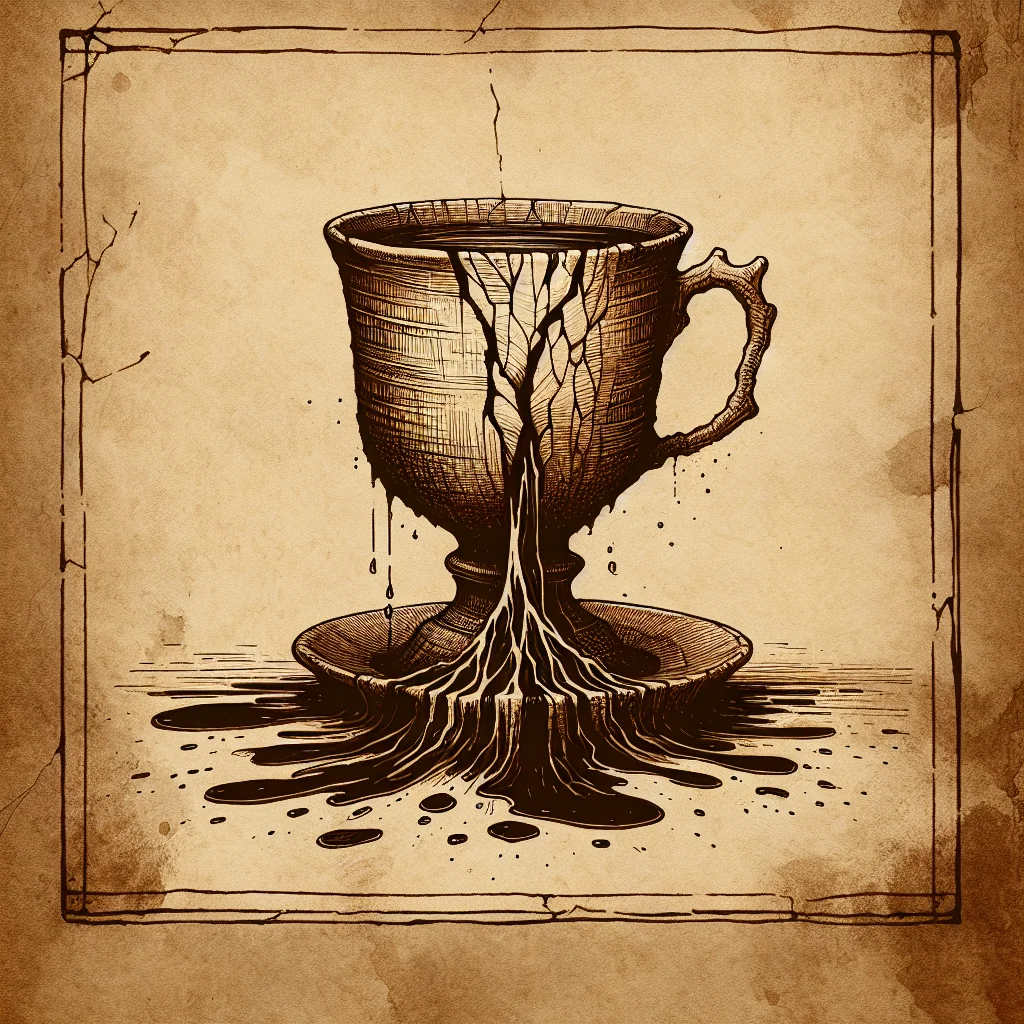
Chapter 2: The Cracks
THE SILENCE THAT followed Kote’s words was the silence before the first note of a song everyone in the room already knew would be unbearable.
Kote stood behind the bar, both hands flat against the wood. He had not moved since he’d spoken. The morning light came through the eastern windows in long, slanting bars, catching the dust and turning it to slow gold. It touched the red of his hair and found it dull. Copper gone to rust.
Outside, the day was grey and close. Not raining, but threatening it, the clouds pressed low against the hills. The trees along the road stood perfectly still. No wind. Not even the memory of wind.
Chronicler waited. He had learned, over two days, that certain silences were load-bearing and should not be disturbed.
The fire had gone to embers overnight, and the common room held a chill that only comes to places that have been warm and are not anymore.
Bast moved first. He unfolded from the hearth with that boneless grace that Chronicler still found unsettling — the movement of something that wore a young man’s shape and sometimes forgot the limitations that implied.
He crossed to the woodbox without a word and began building the fire back up, selecting each piece of split oak with a care that bordered on ritual. He struck the flint once, twice, and coaxed a flame from nothing.
The fire caught. It always caught when Bast tended it.
As the flames built, Bast glanced toward the bar. Just a flicker of his eyes. But Chronicler saw what was in that glance, and it made his chest tight. The look of someone counting the cracks in a dam.
Kote moved at last. He lifted his hands from the bar, flexed his fingers once, and turned to the shelf behind him.
What followed was a performance.
Chronicler had watched it twice now, this morning ritual, and each time it struck him the same way: as something practiced past habit into devotion. Kote wiped down the bar with a cloth folded into precise quarters. He checked the bottles on the shelf, turning each one so the labels faced outward. He washed the three glasses from the night before, though they had been washed already, setting each one upside down on the drying cloth with a small, definitive click.
Every motion measured. Every gesture complete. The innkeeper tending his inn the way a priest tends an altar long after the congregation has gone.
Chronicler was holding his pen. He didn’t remember picking it up. He set it down. This was not part of the story. But he watched anyway, because something in Kote’s movements this morning was different.
On the first morning, Kote’s routine had been armor. On the second morning, habit, the body moving through its patterns while the mind was already deep in the telling.
This morning it was something else. Slower. More careful. As though Kote were memorizing the weight of the cloth in his hand, the grain of the bar beneath his fingertips. A man walking through his house one final time before leaving it forever.
“There’s bread,” Kote said. The same words as yesterday, and the day before. The innkeeper’s liturgy, spoken to the empty room, to the customers who would not come. “And cheese. The cider is warm.”
But his voice caught on the last word, barely. Bast did not miss it. His head turned, sharp and quick, his dark eyes fixed on Kote with an intensity that made the air between them feel taut.
Chronicler helped himself. The bread was fresh this morning, which surprised him. Kote must have been up before dawn, kneading dough, stoking the kitchen fire. The loaf was dense and golden-crusted, still faintly warm. The smell of it — yeast and grain and the ghost of honey — was so impossibly ordinary that something twisted behind his ribs.
He ate at the table nearest the bar. His papers were stacked beside his plate, two days of transcription held down by the inkwell. He did not look at them. He could feel the shape of the story in the stack’s growing weight.
Bast settled onto his stool at the bar, drawing one knee up, resting his chin on it. He did not eat. He watched Kote with the patience of the tide, unable to stop what was being worn away.
The morning aged. The grey light outside thickened but did not brighten. Somewhere in the distance, a dog barked once and fell silent. A cart creaked past on the lane, the sound distant and dull through the thick walls of the inn.
The Waystone absorbed it all and gave nothing back. Present but apart. A waystone, marking a road that no one traveled anymore.
Chronicler finished his bread. Wiped his hands. Unstoppered the inkwell and topped it from the traveling bottle in his satchel. He was nearly through a week’s ink in three days.
He cleaned his pen. Tested the nib against his thumbnail. Laid out a fresh sheet and positioned it just so, aligned with the edge of the table.
His right hand ached, the cramp settled deep into the tendons overnight. He worked the fingers open and closed, willing the stiffness out. Two more days of this and the hand might never unclench. He found he did not care.
When he looked up, he found Kote watching him.
“You’re eager,” Kote said. His voice held something that was almost amusement.
“I’m ready,” Chronicler said.
“There’s a difference?”
“One implies patience. The other implies a pen.” He held up the pen. “I have a pen.”
The corner of Kote’s mouth moved. Not a smile. The memory of a place where smiles had lived.
Bast made a sound, low and soft, that might have been a laugh in a brighter room. He was watching the windows now, tracking something Chronicler couldn’t see. The morning light caught his face at an angle, and for a moment the glamour thinned, the bones beneath rearranging into something sharper, stranger. Then he blinked and was just a young man again, restless on his stool.
“The last day,” Bast said. He said it the same as the last candle, or the last door. A thing that was running out.
“The last day,” Kote agreed.
The silence that followed had weight. The terrible weight of a thing that has been deferred and can be deferred no longer. The weight of a chest that must finally be opened. Of an ending that has been patient long enough.
Chronicler dipped his pen. The ink gleamed on the nib, dark as a promise.
Kote drew a breath. Let it out slowly. His hands found the bar again, palms flat, fingers spread, and Chronicler had the sudden sense that the man was drawing something up through the wood itself — strength or memory or simple stubbornness from the grain of the oak beneath his hands.
“Yesterday I told you about the cracks,” Kote said. “About coming back from Vintas and finding the world different. Finding myself different. The Cthaeh’s words working through me like poison through blood.”
“You did.”
“Today the cracks open.” His voice was quiet. Flat. “Today the cracks become the thing that breaks.”
Outside, the first drops of rain touched the windows. Not heavy. Not yet. Just a pattering, soft and irregular, the sound of something testing the glass before committing to the storm.
Bast’s hand found the edge of the bar and gripped it. The wood creaked.
“I should warn you,” Kote said, watching the rain on the glass. “The first two days, I told you about a young man making mistakes. Falling in love. Chasing the names of things.” He paused. “Today I tell you about what those mistakes cost. Not just me.”
He turned back to them. His eyes were dark and steady, and somewhere behind them, very deep, something that was not Kote and not quite Kvothe looked out at the room.
“Everyone,” he said.
Chronicler’s pen touched the page.
And Kote, slowly, like a man stepping off a cliff he has been standing on for years, began to speak.